This website is used for EDCI 338: Social Media and Personalized Learning at the University of Victoria. It serves as a space for course-related blog posts, reflections, and activities focused on digital identity, personal learning networks, and public communication in online spaces.
As this course progresses, I have become more aware of how learning, identity, and connection are increasingly shaped through digital spaces rather than traditional classroom environments. Although participating in an online course can feel disorienting at times, it also creates opportunities to form new connections and develop a more intentional personal learning network.
A Personal Learning Network (PLN) consists of the people, platforms, and communities that individuals engage with to support learning and knowledge development. Networking through social media often occurs through informal interactions rather than structured outreach. Shared connections can reduce social barriers and make engagement feel more natural, reflecting how learning in networked environments develops organically through participation and interaction rather than hierarchy.
Different digital platforms play distinct roles within a PLN depending on whether they are approached as personal or professional spaces. Platforms such as LinkedIn are primarily used for professional networking, where visibility and engagement are often linked to opportunity. Other platforms, such as Instagram, can function as hybrid spaces that blend personal expression with professional presence depending on how they are curated. In contrast, platforms used mainly for private communication or content consumption contribute less directly to public identity formation. These distinctions illustrate how personal versus professional approaches to digital identity significantly shape patterns of social media use.
Digital identity exists regardless of the level of active participation online. As discussed in the course materials and videos, digital identity is formed through both controlled content, such as posts and profiles, and uncontrolled content, such as tags, connections, or information shared by others. Choosing not to post does not eliminate digital identity but instead shifts how that identity is constructed and who maintains control over it. This highlights the importance of intentional engagement rather than complete withdrawal from digital spaces.
In networked publics, personal and professional identities often converge. Content shared in one context may be accessed by multiple audiences, leading to context collapse. This convergence presents both benefits and challenges. On one hand, it allows individuals to connect with broader communities and access professional and social opportunities. On the other, it increases the need to manage visibility and perception across audiences with differing expectations. Maintaining platform-specific norms and varying levels of privacy can help navigate this complexity.
Reflecting on controlled and uncontrolled aspects of my digital presence has reinforced the idea that digital identity is an ongoing process rather than a fixed outcome. While privacy and limited visibility remain important to me, participation in professional digital spaces plays a role in supporting learning and creating opportunities. Moving forward, my goal is to continue developing a digital identity that balances authenticity, privacy, and intentional engagement within my personal learning network.
🎵 Song currently on repeat: “No One Noticed” (Instrumental)
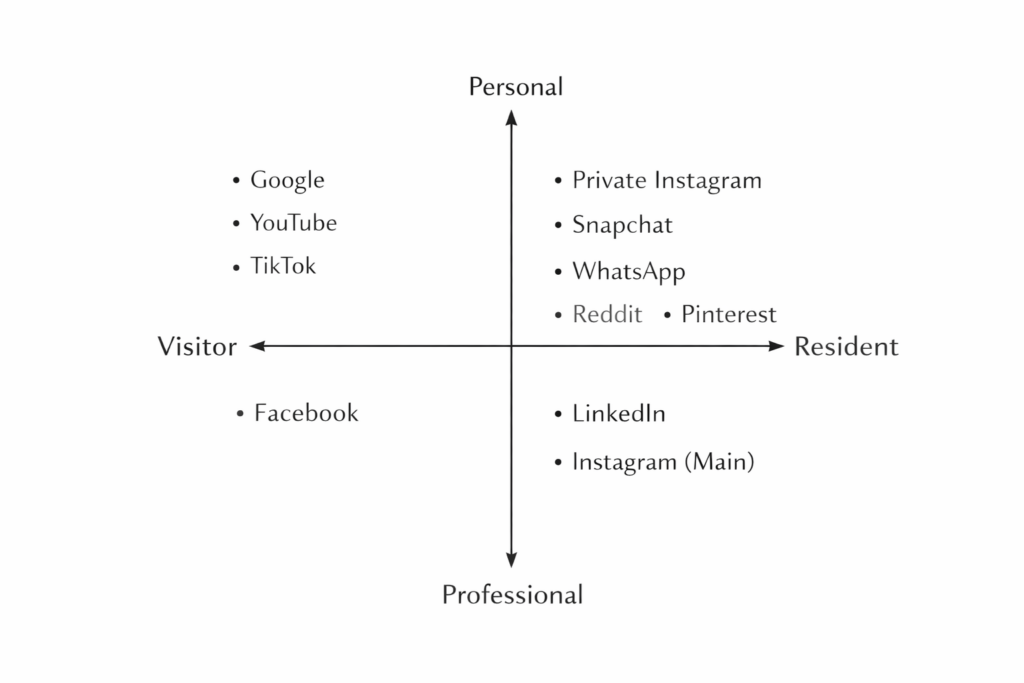
The Visitor and Resident framework offers a useful way to understand how individuals engage with digital platforms based on identity and presence rather than frequency of use. Rather than measuring how often a platform is accessed, the model emphasizes whether a user treats a platform as a tool for consumption (Visitor) or as a space where identity is expressed and maintained (Resident). Mapping my own digital practices allowed me to reflect more critically on how my personal learning network and digital identity are shaped across platforms.
As a Visitor, I primarily use platforms such as Google, YouTube, and TikTok. These spaces function as tools rather than identity-based environments. While the content I consume on these platforms strongly influences my thinking and interests, I leave little visible trace. I do not post, comment, or maintain a public presence. This aligns with discussions of networked publics, where participation can range from passive consumption to active identity performance (boyd, 2007).
In contrast, I act as a Resident on platforms where I maintain a clear and intentional identity. LinkedIn is the strongest example of this. My presence there is professional, curated, and purpose-driven. I engage when there is a reason to do so, such as professional networking or event participation, rather than passive scrolling. This reflects Eric Stoller’s argument that digital identity is not simply about being online, but about how intentionally one chooses to be visible and identifiable in digital spaces (Stoller, 2016).
Instagram occupies a more complex position within my Visitor and Resident map. On my main account, I am a light resident. I am identifiable and occasionally active, but I post infrequently and maintain a high level of control over visibility. On a private account restricted to close friends, I am far more active and expressive. This distinction reflects what Spracklen (2015) describes as identity-making across social media, where individuals perform different versions of themselves depending on audience and context.
Messaging platforms such as Snapchat and WhatsApp also function as resident spaces, though they are private rather than public. These platforms support ongoing identity-based interaction but do not significantly contribute to a public digital footprint. Their role in my personal learning network is relational rather than performative, and that not all meaningful digital participation is publicly visible.
Considering my digital presence from an employer’s perspective highlights the importance of controlled and uncontrolled content. If an employer were to search my name, they would primarily encounter my LinkedIn profile. This presents a professional and controlled digital identity, with minimal risk of misinterpretation. However, it also limits personal context. As discussed in course materials on privacy, ethics, and surveillance, managing visibility involves balancing opportunity with control rather than complete withdrawal from digital spaces (Regan & Miller, 2019).
I primarily use platforms such as LinkedIn and Instagram to develop professional networks. Instagram, in particular, enables informal networking that can lead to professional opportunities. Reflecting on my Visitor and Resident map has made me more aware that while I use digital platforms effectively as tools, I do not yet fully leverage them as networking spaces within my personal learning network.
Overall, digital identity is ongoing, contextual, and shaped by intentional choices. The Visitor and Resident framework helped me recognize how privacy, participation, and identity intersect across platforms. Moving forward, I see value in developing a slightly more active and intentional presence in professional contexts, while still maintaining the boundaries that support privacy and control.