This website is used for EDCI 338: Social Media and Personalized Learning at the University of Victoria. It serves as a space for course-related blog posts, reflections, and activities focused on digital identity, personal learning networks, and public communication in online spaces.
Blog Post #3
What Inclusion & Community Engagement Looks Like in My PLN
Reflecting on my Personal Learning Network (PLN) through the lens of inclusion and community engagement has made me more aware of both its strengths and its limitations. While my PLN supports inspiration, motivation, and informal learning, this course has encouraged me to think more critically about whose voices I am exposed to, how inclusive my learning spaces are, and how intentional I am in shaping them.
Perspective is shaped by what we choose to observe and engage with.
Figure 1. Silhouetted figure overlooking a city at night, representing observation and perspective in learning. Image sourced from Pinterest, used for educational purposes. https://ca.pinterest.com/pin/245657354670012206/
My PLN currently includes friends and peers my age, creators on social media, and online communities centered around interests such as business, artificial intelligence, travel, fashion, and lifestyle. Much of my learning happens informally through platforms like YouTube and Reddit, where I engage with discussions, ideas, and problem-solving content without actively contributing publicly. Instagram plays a different role in my PLN, functioning more as a social and inspirational space rather than a primary source of learning.
While my PLN does expose me to different cultures and lifestyles, particularly through travel content and global creators, it is not especially diverse in terms of perspectives or disciplines. My feed is largely shaped by my own interests and interactions, which reinforces certain viewpoints while limiting exposure to others. This aligns with course discussions around how social media algorithms often amplify familiar content rather than challenging users to engage with unfamiliar perspectives.
Before taking this course, I did not consciously think about inclusion as part of my PLN. Networking and learning felt personal and interest-driven rather than values-driven. Through course readings and discussions, I have begun to understand that inclusion is not only about who is represented, but also about whose voices are amplified and whose perspectives are consistently centered. Moore and Schnellert (2017) emphasize that inclusion is not separate from learning, but essential to it. Learning without diverse perspectives limits understanding and reinforces narrow worldviews.
In a professional context such as business and entrepreneurship, social media has the potential to support more inclusive communication by increasing access, visibility, and participation. Platforms allow individuals from different backgrounds to share ideas, challenge dominant narratives, and build communities beyond geographic or institutional boundaries. At the same time, social media also presents challenges. Misinterpretation, performative inclusion, and fear of backlash can discourage meaningful engagement. As Clark and Aufderheide (2010) note, participatory media is most effective when it is open, dynamic, and genuinely inclusive rather than symbolic.
From an employer’s perspective, maintaining a public and engaging PLN requires awareness of organizational policies and professional expectations. Social media policies often encourage caution and neutrality, which can limit open expression but also protect individuals and organizations from harm. While I tend to prioritize privacy and avoid public posting, this reflection has helped me recognize that responsible engagement does not require abandoning boundaries. Instead, it involves intentional participation and thoughtful amplification of others when appropriate.
One learning outcome of reflecting on my PLN is increased awareness of how easily learning environments can become repetitive and insular. I have become more conscious of the need to engage intentionally with diverse perspectives rather than relying solely on algorithm-driven content. Moving forward, I aim to be more reflective about who I follow, what content I engage with, and how my PLN can support broader understanding without requiring constant public expression.
Overall, this reflection has shifted my understanding of PLNs from passive networks of interest to active spaces of learning and responsibility. Inclusion within a PLN is not about performative action, but about awareness, intentionality, and openness to perspectives beyond one’s immediate circle.
References / Course Materials
Moore, S., & Schnellert, L. (2017). One Without the Other: Stories of Unity Through Diversity and Inclusion. Introduction & Part 1.
Clark, J., & Aufderheide, P. (2010). A New Vision for Public Media: Open, Dynamic, and Participatory. In Media & Social Justice (Chapter 4).
PLN Diversity, Inclusion, and Social Media. Course YouTube Channel.
Community Communications. Course YouTube Channel.
3 Responses to “Blog Post #3”
E
Hi there! I agree that we do need to be more aware about who we follow so that we do include diverse perspectives. I also do find that learning can be repetitive sometimes too!
remd
I thought your introspection re: limiting one’s own exposure is important, especially in the context of your earlier point re: the instructional vs. inspirational role of different social networks. When we want to learn how to do a specific thing, there’s some loss of diversity by necessity. But when we want to generate new ideas, there’s no such limit on the value of different perspectives. This may mean that if you’re trying to increase the diversity of your own PLN, a good place to start would be adjusting your algorithm on platforms where you center creativity (like Instagram).
skychantian
Hi! I really liked how you framed responsible participation as being intentional rather than always being visible or outspoken. The way you connected boundaries, privacy, and professional responsibility felt very thoughtful. It made me rethink how meaningful engagement doesn’t always require constant public expression.
As this course progresses, I have become more aware of how learning, identity, and connection are increasingly shaped through digital spaces rather than traditional classroom environments. Although participating in an online course can feel disorienting at times, it also creates opportunities to form new connections and develop a more intentional personal learning network.
A Personal Learning Network (PLN) consists of the people, platforms, and communities that individuals engage with to support learning and knowledge development. Networking through social media often occurs through informal interactions rather than structured outreach. Shared connections can reduce social barriers and make engagement feel more natural, reflecting how learning in networked environments develops organically through participation and interaction rather than hierarchy.
Different digital platforms play distinct roles within a PLN depending on whether they are approached as personal or professional spaces. Platforms such as LinkedIn are primarily used for professional networking, where visibility and engagement are often linked to opportunity. Other platforms, such as Instagram, can function as hybrid spaces that blend personal expression with professional presence depending on how they are curated. In contrast, platforms used mainly for private communication or content consumption contribute less directly to public identity formation. These distinctions illustrate how personal versus professional approaches to digital identity significantly shape patterns of social media use.
Digital identity exists regardless of the level of active participation online. As discussed in the course materials and videos, digital identity is formed through both controlled content, such as posts and profiles, and uncontrolled content, such as tags, connections, or information shared by others. Choosing not to post does not eliminate digital identity but instead shifts how that identity is constructed and who maintains control over it. This highlights the importance of intentional engagement rather than complete withdrawal from digital spaces.
In networked publics, personal and professional identities often converge. Content shared in one context may be accessed by multiple audiences, leading to context collapse. This convergence presents both benefits and challenges. On one hand, it allows individuals to connect with broader communities and access professional and social opportunities. On the other, it increases the need to manage visibility and perception across audiences with differing expectations. Maintaining platform-specific norms and varying levels of privacy can help navigate this complexity.
Reflecting on controlled and uncontrolled aspects of my digital presence has reinforced the idea that digital identity is an ongoing process rather than a fixed outcome. While privacy and limited visibility remain important to me, participation in professional digital spaces plays a role in supporting learning and creating opportunities. Moving forward, my goal is to continue developing a digital identity that balances authenticity, privacy, and intentional engagement within my personal learning network.
🎵 Song currently on repeat: “No One Noticed” (Instrumental)
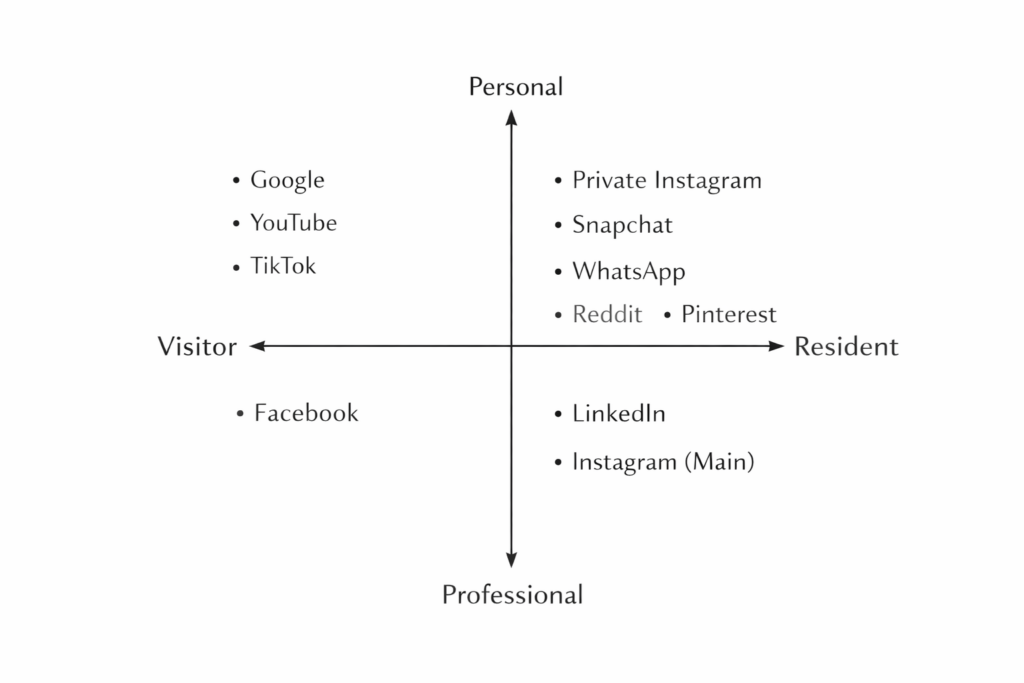
The Visitor and Resident framework offers a useful way to understand how individuals engage with digital platforms based on identity and presence rather than frequency of use. Rather than measuring how often a platform is accessed, the model emphasizes whether a user treats a platform as a tool for consumption (Visitor) or as a space where identity is expressed and maintained (Resident). Mapping my own digital practices allowed me to reflect more critically on how my personal learning network and digital identity are shaped across platforms.
As a Visitor, I primarily use platforms such as Google, YouTube, and TikTok. These spaces function as tools rather than identity-based environments. While the content I consume on these platforms strongly influences my thinking and interests, I leave little visible trace. I do not post, comment, or maintain a public presence. This aligns with discussions of networked publics, where participation can range from passive consumption to active identity performance (boyd, 2007).
In contrast, I act as a Resident on platforms where I maintain a clear and intentional identity. LinkedIn is the strongest example of this. My presence there is professional, curated, and purpose-driven. I engage when there is a reason to do so, such as professional networking or event participation, rather than passive scrolling. This reflects Eric Stoller’s argument that digital identity is not simply about being online, but about how intentionally one chooses to be visible and identifiable in digital spaces (Stoller, 2016).
Instagram occupies a more complex position within my Visitor and Resident map. On my main account, I am a light resident. I am identifiable and occasionally active, but I post infrequently and maintain a high level of control over visibility. On a private account restricted to close friends, I am far more active and expressive. This distinction reflects what Spracklen (2015) describes as identity-making across social media, where individuals perform different versions of themselves depending on audience and context.
Messaging platforms such as Snapchat and WhatsApp also function as resident spaces, though they are private rather than public. These platforms support ongoing identity-based interaction but do not significantly contribute to a public digital footprint. Their role in my personal learning network is relational rather than performative, and that not all meaningful digital participation is publicly visible.
Considering my digital presence from an employer’s perspective highlights the importance of controlled and uncontrolled content. If an employer were to search my name, they would primarily encounter my LinkedIn profile. This presents a professional and controlled digital identity, with minimal risk of misinterpretation. However, it also limits personal context. As discussed in course materials on privacy, ethics, and surveillance, managing visibility involves balancing opportunity with control rather than complete withdrawal from digital spaces (Regan & Miller, 2019).
I primarily use platforms such as LinkedIn and Instagram to develop professional networks. Instagram, in particular, enables informal networking that can lead to professional opportunities. Reflecting on my Visitor and Resident map has made me more aware that while I use digital platforms effectively as tools, I do not yet fully leverage them as networking spaces within my personal learning network.
Overall, digital identity is ongoing, contextual, and shaped by intentional choices. The Visitor and Resident framework helped me recognize how privacy, participation, and identity intersect across platforms. Moving forward, I see value in developing a slightly more active and intentional presence in professional contexts, while still maintaining the boundaries that support privacy and control.
Hey Zena, first off I wanted to let you know that I really appreciate how you organized your blog. It’s very creative and visually striking, nicely done! As per your post I love how you organized your thoughts this way, I took a much more philosophical approach to the response but how you incorporated the readings into your typical engagement online was fascinating. In particular I loved how you addressed the variety in how we engage on platforms such as Instagram that while traceable are able to be utilized in both a professional and personal manner depending on who you allow access to your content and how you engage visibly on public (professional accounts) such as suppressing likes, comments, etc. and it really does align well with Stoller’s point on being “visible and identifiable in digital spaces”, this is somewhat subconscious in our modern lives as being online have become equivalent to being alive in others eyes. It makes me wonder if we stay in this passive state online as often as we do when we’re aware of the impression we are making and if it would impact how others view us outside the digital atmosphere? At any rate, I’m glad to hear you’re planning to heighten your awareness of your digital reputation while still enjoying engaging with friends and social platforms in your personal life.
Blog Post #4
Media Literacy and Public Responsibility in a Social Media News Environment
As social media increasingly replaces traditional news consumption, media literacy becomes less optional and more essential. In a connected society where information spreads instantly, the ability to evaluate, verify, and responsibly engage with content is critical. Reflecting on this week’s materials has shifted my understanding of media literacy from a technical skill to a responsibility, particularly in spaces where public trust is involved.
Unlike previous generations, I do not regularly watch television news or read full-length articles unless required. Most of my exposure to current events comes from short-form social media content: reels, informational videos, and creators who summarize complex topics in accessible formats. These creators often present themselves confidently and persuasively, which can make their content feel credible. I frequently share these videos with friends, and we often question whether the information is accurate. However, I rarely verify claims through primary sources.
For example, after repeatedly seeing content about the risks associated with farmed salmon, I changed my purchasing habits to only buy wild-caught salmon. Reflecting through a media literacy lens raises an important question: did I independently verify these claims, or was I influenced by repetition, presentation style, and perceived authority? This illustrates how informational creators on social media function as informal “positions of trust.” Even without traditional journalistic credentials, they shape consumer behaviour and public understanding.
The example on the left is the kind of financial content I regularly see on Instagram. It uses a recognizable institution and a dramatic price prediction to grab attention. The bold design makes it feel urgent and convincing. Without looking into the full analysis behind it, it is easy to absorb simplified information without fully evaluating the claim.
Figure 1. A financial prediction post that appeared on my Instagram feed. Included for educational reflection in EDCI 338.
The course interview with Sophie Lui emphasized the importance of verification, accountability, and careful communication in journalism. Traditional media environments typically include editorial oversight, fact-checking processes, and corrections when errors occur. In contrast, short-form content creators often operate independently, without structured review processes. While this allows for accessibility and speed, it also increases the risk of oversimplification, partial truths, or emotionally framed narratives designed to maximize engagement rather than clarity.
Trilling and Fadel (21st Century Skills) describe media literacy as the ability to analyze messages, evaluate credibility, and understand how media shapes perception. In a social media ecosystem driven by algorithms, content that evokes strong emotion often spreads more quickly than content grounded in nuance. This dynamic can create environments where misinformation or incomplete information circulates widely before being critically examined.
Engaging with a public audience carries both benefits and risks. Benefits include reach, accessibility, and the ability to build community across geographic boundaries. Social media democratizes information sharing and allows diverse voices to contribute to public discourse. However, risks include misinterpretation, reputational damage, and the amplification of inaccurate information. Once posted, content can be shared, screenshotted, or taken out of context permanently.
Open conversations about factual accuracy can also create conflict. As Hirst notes in discussions of fake news and media systems, information is often entangled with identity and ideology. When beliefs become tied to personal identity, correcting misinformation can feel like a personal attack rather than an intellectual discussion. Additionally, algorithmic amplification of outrage can intensify polarization rather than promote constructive dialogue.
From a professional perspective, curating a public social media presence requires intentionality. If I were to share informational content publicly, I would need to prioritize cross-checking sources, distinguishing clearly between opinion and fact, and being transparent about uncertainty. Choosing not to post can also be a form of responsibility. In a high-velocity information environment, restraint can be as important as participation.
Reflecting on this week’s materials has made me more aware of how easily exposure becomes influence. Even without actively posting, my consumption patterns shape my beliefs and behaviours. Media literacy is therefore not only about what we share publicly, but also about how critically we evaluate what we consume privately.
In a connected society, a strong PLN is not only diverse and inclusive, but also grounded in credible, verifiable information. Media literacy strengthens both personal judgment and public discourse, making it a foundational skill in digital environments.
References / Course Materials
Trilling, B., & Fadel, C. (2009). 21st Century Skills – Learning for Life in Our Times. Media Literacy section (pp.66). Hirst, M. (Chapter 4). The Political Economy of Fake News. Media Literacy – Media Smarts Facts Matter. Course YouTube Channel. Interview with Sophie Lui – Course YouTube Channel.
Personal Learning Networks and Education Discourse
Education discourse has traditionally taken place in classrooms, academic journals, and conferences. However, digital platforms have expanded these spaces significantly. Through personal learning networks (PLNs), individuals are now exposed to a wide range of ideas and explanations that extend beyond formal educational environments.
A Personal Learning Network (PLN) refers to the collection of people, platforms, and resources individuals use to support their learning. For many students today, this network exists across multiple digital platforms. In my own experience, YouTube and ChatGPT have become some of the most useful tools for learning. Even in high school, teachers sometimes used YouTube videos to explain complex topics because the explanations were clearer and more accessible than traditional lectures.
PLNs can help develop ideas within education discourse by expanding access to knowledge and perspectives. Online platforms allow individuals to engage with explanations, discussions, and resources from people around the world rather than only hearing viewpoints from their local classroom or community. As Alec Couros explains in Developing Personal Learning Networks for Open and Social Learning, digital networks allow learning to move beyond institutional boundaries by connecting individuals to wider communities and resources.
At the same time, PLNs can also limit idea development. Social media algorithms often reinforce the types of content users already interact with, which means people may repeatedly encounter similar viewpoints. Over time, repeated exposure to the same types of content can reinforce certain perspectives while limiting exposure to alternative interpretations. This highlights how the information people regularly encounter online can shape how they think.
Social media also plays an increasing role in education discourse. Educators, researchers, and professionals now share ideas publicly through blogs, videos, and online discussions. These platforms make educational information more accessible and allow conversations to develop outside traditional institutions. However, not all information shared online is equally reliable, and some users may accept simplified explanations without verifying the source.
Different platforms also serve different roles within educational PLNs. In my experience, YouTube and ChatGPT are the most useful platforms for learning because they provide detailed explanations and allow people to explore topics more deeply. Other platforms, such as Instagram, often function more as social or inspirational spaces rather than primary sources of educational content.
When educators work with vulnerable groups, the role of social media becomes more complex. Expectations around social media often depend on the educational setting and the age of the students involved. While post-secondary students manage their own online presence, younger students may require clearer boundaries and parental involvement. These situations highlight the importance of professionalism and awareness when social media intersects with education.
Reflecting on this course has not dramatically changed how I personally use social media, but it has made me more aware of how digital platforms shape learning environments. I still value privacy and maintain a limited public presence online, but I now better understand how PLNs influence learning and professional development. Social media can support meaningful learning and discourse, but its impact ultimately depends on how individuals choose to engage with it.
References / Course Materials
Couros, A. (2010). Developing Personal Learning Networks for Open and Social Learning. Chapter 8.
Incorporating & Accounting for Social Media in Education. Course YouTube Channel.
Blog Post #6
Reflecting on My Personal Learning Network
Before taking this course, I had never heard the term “Personal Learning Network” (PLN). However, I now realize that I already had one. I regularly learned from different online platforms and communities, but I had never thought about them as part of a structured network of learning. This course mainly helped me recognize and reflect on something that was already part of my daily habits.
My PLN includes several digital platforms that support different types of learning. The most important ones for me are YouTube and ChatGPT. I often use YouTube to understand concepts explained visually or step-by-step, and it has been a useful learning tool since high school. In many cases, even teachers relied on YouTube videos because the explanations were clearer and easier to follow. ChatGPT has also become one of my main learning tools because it allows me to ask questions and explore topics quickly. I also use Reddit frequently for discussions where people explain ideas or share experiences related to certain topics.
My overall behavior online has not changed dramatically during this course. However, I have become more aware of how my learning is influenced by the platforms I use. Recently, I have noticed myself watching slightly less YouTube and more short-form content such as Instagram Reels or TikTok. This shift was not intentional, but it reflects how platform design and algorithms can shape how people consume information.
Even though my habits have stayed mostly the same, the course encouraged me to reflect more on my digital identity and how I present myself online. I have always been careful about what I post on social media, but this course made me think more about how online activity can influence professional opportunities and networking.
Social media can play an important role in professional development when used intentionally. It allows people to connect with others, discover new ideas, and build networks beyond their immediate environment. In many cases, it is easier to connect with someone online than in person because platforms make it easier to find people with shared interests or professional goals.
One of the key ideas reinforced during this course is the importance of networking online. Around the time the course began, I started realizing how valuable digital networking can be, particularly in professional spaces. Although I am not extremely active on platforms like LinkedIn, I understand that maintaining a presence online can create opportunities to connect with others in similar fields.
A successful PLN, in my opinion, provides reliable information, useful connections, and access to resources that support learning and professional development. People naturally curate their networks around their interests, which means the information they see is shaped by what they choose to engage with. Personally, I prefer platforms that are curated to my interests rather than completely unfiltered spaces.
Overall, this course did not dramatically change how I use social media, but it did help me understand how digital networks influence learning, communication, and professional development. Recognizing how PLNs function has made me more aware of how people build knowledge and connections in a digital environment.
A Personal Learning Network (PLN) includes the people, platforms, and communities that influence how someone learns. While digital tools play a major role in modern PLNs, learning networks are not limited to online spaces. Conversations with friends and family, personal experiences, and everyday interactions can also shape how people develop knowledge and perspectives.
In my own PLN, both online platforms and personal connections play a role. The platforms I use the most are Instagram and TikTok, but I mainly use them for general content rather than learning. When I actually want to understand something better, I usually turn to YouTube, ChatGPT, Reddit, or just searching on Google or Safari. I also learn a lot from conversations with friends and family who share ideas, information, or things they have come across online.
Artificial intelligence has become one of the most important tools in my PLN. ChatGPT, in particular, is something I use frequently when I want to learn something quickly or understand a concept better. It allows me to ask questions and explore topics at my own pace. Compared to traditional lectures, this makes learning feel more flexible because I can go step-by-step and ask follow-up questions whenever something is unclear.
At the same time, AI and algorithms also shape what information people see online. Social media platforms recommend content based on what users interact with most, which means feeds quickly become curated around personal interests. This can make content feel more relevant, but it can also reduce exposure to different viewpoints. If someone constantly interacts with low-quality or misleading content, the algorithm may continue reinforcing that type of information.
This reflects both the strengths and weaknesses of modern PLNs. One major advantage is how fast and accessible information has become. Platforms like YouTube, Reddit, and AI tools make it possible to learn from people all over the world and access explanations that might not exist in traditional classrooms. These networks can also support professional growth by helping people connect with others who share similar interests or career goals.
However, there are also downsides. Short-form content and algorithm-driven feeds often prioritize entertainment and engagement over deeper learning. Many people, especially within younger generations, spend a lot of time consuming short videos that provide quick bursts of information but very little depth. This environment can sometimes lead to what people refer to as “brain rot,” where content becomes repetitive, overly simplified, or designed mainly to keep users scrolling.
Misinformation is another challenge. Because anyone can share information online, not everything people encounter is reliable. Without strong digital literacy skills, it can be difficult to determine whether a source is trustworthy or not.
Despite these issues, AI and digital platforms have significantly improved access to knowledge. AI tools make it easier to explore ideas, ask questions, and receive explanations instantly. However, relying too heavily on AI could also reduce opportunities for deeper critical thinking if people become used to receiving answers immediately instead of working through problems themselves.
Overall, my PLN reflects both the opportunities and challenges of the evolving internet. Digital platforms and AI have made learning more accessible than ever before, but they also require users to be aware of how algorithms and content systems shape the information they see. Understanding this balance is important for using PLNs in ways that support meaningful learning and professional development.
References / Course Materials
Estaiteyeh, M., & Mindzak, M. (2024). Building AI literacy in pre-service teacher education in Canada. Journal of Open, Flexible, and Distance Learning, 28(1), 144–162. https://search.library.uvic.ca/permalink/01VIC_INST/1ohem39/cdi_doaj_primary_oai_doaj_org_article_5dd680fc781d4e7e84dda7aa36ee0ec5
Kennedy, C. (n.d.). Culture of Yes [Blog]. https://cultureofyes.ca/
Blog Post #8
AI, Social Media, and Misinformation
Artificial intelligence has made it much easier for content to be created and spread on social media, but it has also made it harder to tell what is real. One thing I have noticed on my own feed is how often I come across content that looks convincing, but I am not fully sure if it is true.
For example, I often see financial and trending posts with bold claims, large numbers, or references to major institutions. These posts usually look professional and are widely shared, which makes them seem credible. When I see this type of content, I sometimes question it, but I also do not always take the time to verify it. Other times, I just ignore it and move on. This shows how easy it is to consume information without fully evaluating it.
I have also seen content where it is unclear whether something is real or not, such as videos or claims about well-known people or events. In these situations, I am often left unsure of what is accurate. Even if I do not fully believe the content, repeated exposure can still influence how I think about it.
AI contributes to this problem by making content more convincing and easier to spread. Even when posts are created by humans, AI systems play a role in how often they appear and how widely they are shared. Algorithms prioritize content that is engaging, dramatic, or widely interacted with, which increases the visibility of certain types of information. When many people engage with the same content, it can start to feel more true, even if it lacks full context.
According to MediaSmarts, there is growing concern in Canada about AI-driven misinformation and how difficult it has become to distinguish between real and generated content. AI allows for the creation of visuals and messages that appear credible, which can make misleading information more persuasive. Similarly, reports from the Digital Artificial Intelligence Society (DAIS) highlight the need for stronger digital literacy skills, as users are increasingly exposed to content shaped by algorithms and AI systems.
The impact of this type of misinformation can shape public opinion over time. When people repeatedly see simplified or exaggerated claims, it can influence how they understand topics, even if they do not fully believe the information. As more people engage with and share this content, it can become normalized and harder to question.
To address this issue, media literacy should focus on simple and practical habits. One key rule is to pause and think before accepting information. This includes checking the source, comparing it with other information, and recognizing when content is designed to attract attention rather than provide full context. Developing these habits can help reduce the spread of misinformation.
Overall, AI has made information more accessible, but it has also made it more difficult to evaluate. My experience shows that even when I question what I see, I do not always verify it and highlights the importance of critical thinking and media literacy when engaging with content online.
Personal Learning Networks (PLNs) offer a lot of benefits for learning, communication, and professional development, but they also rely heavily on data collection. Platforms that support PLNs, such as social media and online tools, collect and use personal information in ways that are not always clear to users.
Personally, I am aware that my data is being collected, but I do not actively try to stop it. I see it as something that is inevitable when using technology. Even if I choose not to accept cookies, I know that platforms like Instagram, TikTok, and other apps already have access to a large amount of information. When using these platforms, it feels like you are already agreeing to that level of data collection.
At the same time, I have noticed how accurate targeted ads can be. For example, after talking about or buying a product, I have seen ads for similar things appear shortly after. This shows how closely platforms track user behavior. While this can feel uncomfortable, it also shows how effective personalization has become.
There are both positives and negatives to this. On one hand, personalized content can be more relevant. Instead of everyone seeing the same generic ads, users are shown content that matches their interests. On the other hand, this also means that platforms are influencing what people see and consume. Since users are essentially the product, the content they are shown is not random but shaped by data collection and algorithms.
In educational settings, this creates some concerns. While PLNs and digital tools are useful for learning, there should still be limits on how student data is collected and used. Students often do not have full control over their information, and it is not always clear how their data is being used by third-party platforms.
Canadian privacy frameworks such as the Personal Information Protection and Electronic Documents Act (PIPEDA) aim to regulate how organizations collect and use personal data. However, in practice, especially with online learning tools and social media, it can still feel like users have limited control. This means that awareness and critical thinking become important when using these platforms.
If I were in a position such as a teacher or employer, I would still allow social media tools because they are already integrated into everyday life and learning. However, I would also recognize the importance of understanding how these platforms collect and use data.
Overall, I think privacy in PLNs is important, but it is also something that many people accept as part of using modern technology. While I am aware of data collection and somewhat cautious, I do not actively try to avoid it because it feels difficult to control. This shows that while privacy matters, many users rely on their own judgment and awareness when navigating digital environments.






3 Responses to “Blog Post #3”
Hi there! I agree that we do need to be more aware about who we follow so that we do include diverse perspectives. I also do find that learning can be repetitive sometimes too!
I thought your introspection re: limiting one’s own exposure is important, especially in the context of your earlier point re: the instructional vs. inspirational role of different social networks. When we want to learn how to do a specific thing, there’s some loss of diversity by necessity. But when we want to generate new ideas, there’s no such limit on the value of different perspectives. This may mean that if you’re trying to increase the diversity of your own PLN, a good place to start would be adjusting your algorithm on platforms where you center creativity (like Instagram).
Hi! I really liked how you framed responsible participation as being intentional rather than always being visible or outspoken. The way you connected boundaries, privacy, and professional responsibility felt very thoughtful. It made me rethink how meaningful engagement doesn’t always require constant public expression.